
Beyond Budget Releases: The Missing Story in Ghana’s 2026 Education Mid-Year Review
Introduction
Ghana’s education sector remains one of the most critical pillars for national development, human capital formation, and long-term economic growth. Every year, the Mid-Year Fiscal Policy Review offers a vital checkpoint not just on spending, but on whether promised reforms are translating into real improvements in classrooms across the country.
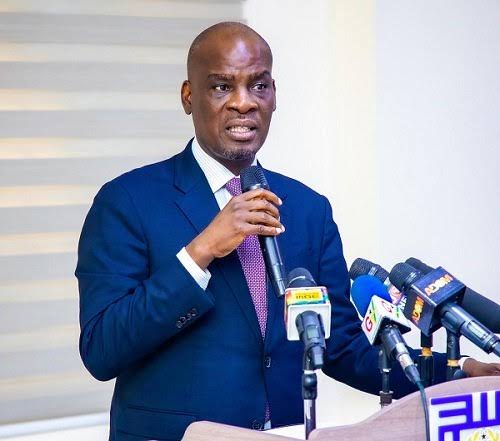
In his insightful opinion piece published, Dr. Peter Anti Partey (Lecturer at the University of Cape Coast and Executive Director of IFEST-Ghana) dissects the 2026 Mid-Year Review’s coverage of the education sector. While the government has demonstrated commendable fiscal discipline and progress on several high-profile initiatives, significant commitments from the original 2026 Budget Statement appear to have fallen through the reporting cracks.
Stable Funding: A Positive Signal of Fiscal Commitment
One of the strongest takeaways from the Mid-Year Review is the government’s adherence to the approved 2026 education budget. The Ministry of Education was allocated approximately GH¢33.76 billion in Government of Ghana (GoG) resources, broken down as follows:
- GH¢32.35 billion for compensation of employees
- GH¢1.39 billion for goods and services
- GH¢20 million for capital expenditure
Additional inflows were expected from Internally Generated Funds (IGF), Development Partners, and the Ghana Education Trust Fund (GETFund).
Crucially, no supplementary budget was requested, and only internal realignments occurred within existing ceilings. This stability contrasts with past years of frequent budget adjustments and signals a maturing approach to public financial management in the education sector.
Notable Progress on Flagship Programmes
The Mid-Year Review highlights tangible implementation in several key areas:
-
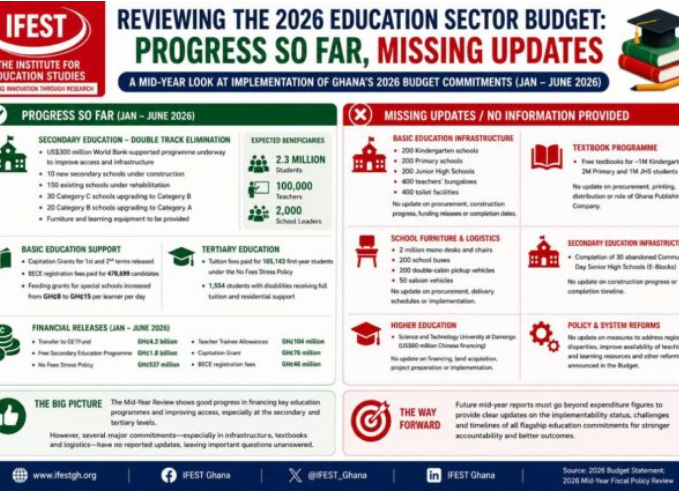
Ending the Double-Track System A major highlight is the commencement of a US$300 million World Bank-supported programme. This will fund:
- Construction of 10 new senior high schools
- Rehabilitation of 150 existing schools
- Upgrades for Category C and B schools
- Furniture and learning equipment
The initiative is projected to benefit 2.3 million students, 100,000 teachers, and 2,000 school leaders.
-
Basic Education Support
- Capitation Grants released for the first and second terms of the 2025/2026 academic year.
- BECE registration fees paid for 478,699 public school candidates.
- Feeding grants for special schools increased from GH¢8 to GH¢15 per learner per day.
-
Tertiary Education – No Fees Stress Policy Tuition fees paid for 165,143 first-year students, plus full support for 1,554 students with disabilities.
-
Key Disbursements (actual releases, not just promises):
- GH¢4.2 billion to GETFund
- GH¢1.8 billion for Free SHS
- GH¢537 million for No Fees Stress
- GH¢104 million for Teacher Trainee Allowances
- GH¢76 million for Capitation Grants
- GH¢46 million for BECE fees
These figures represent a shift from planning to execution a welcome development.
What the Mid-Year Review Left Out
Despite these achievements, Dr. Partey rightly points out that the Review provides only a partial picture. Several ambitious commitments announced in the 2026 Budget Statement received little or no mention:
- Basic Education Infrastructure Programme: Plans to build 200 kindergartens, 200 primary schools, 200 JHS, 400 teachers’ bungalows, and 400 toilet facilities in underserved areas. No updates on procurement, progress, or timelines.
- National Textbook Programme: Free textbooks for ~1 million KG, 2 million primary, and 1 million JHS students. Silence on production, distribution, or procurement status.
- Educational Logistics: Procurement of 2 million mono desks, 200 school buses, 200 double-cabin pickups, and 50 saloon vehicles no implementation updates.
- Completion of E-Blocks: Finishing 30 abandoned Community Day Senior High Schools (E-Blocks) to ease congestion. No progress reported.
- Science and Technology University in Damongo: A major higher education expansion project backed by ~US$60 million from China. No updates on financing or timelines.
These omissions matter because infrastructure, teaching materials, and equitable access are foundational to improving learning outcomes not just enrolment.
Ghana’s Education Challenges
Ghana has made impressive gains in access over the past decades (e.g., Free SHS and improved Gross Enrolment Ratios), but quality and equity remain persistent issues. Regional disparities, teacher shortages in rural areas, inadequate infrastructure, and learning poverty continue to challenge the system.
The 2026 budget maintained strong nominal allocations to education (around 16% of the national budget in recent cycles), yet execution gaps and reporting shortfalls can undermine public trust and donor confidence.
About The Author