
GTEC Withdraws Retirement Age and Post-Retirement Contract Directive Following Ministerial Order
In a swift response to directives from the Minister for Education, the Ghana Tertiary Education Commission (GTEC) has officially withdrawn its controversial policy directive on retirement age and post-retirement contracts for senior academic members in public universities.
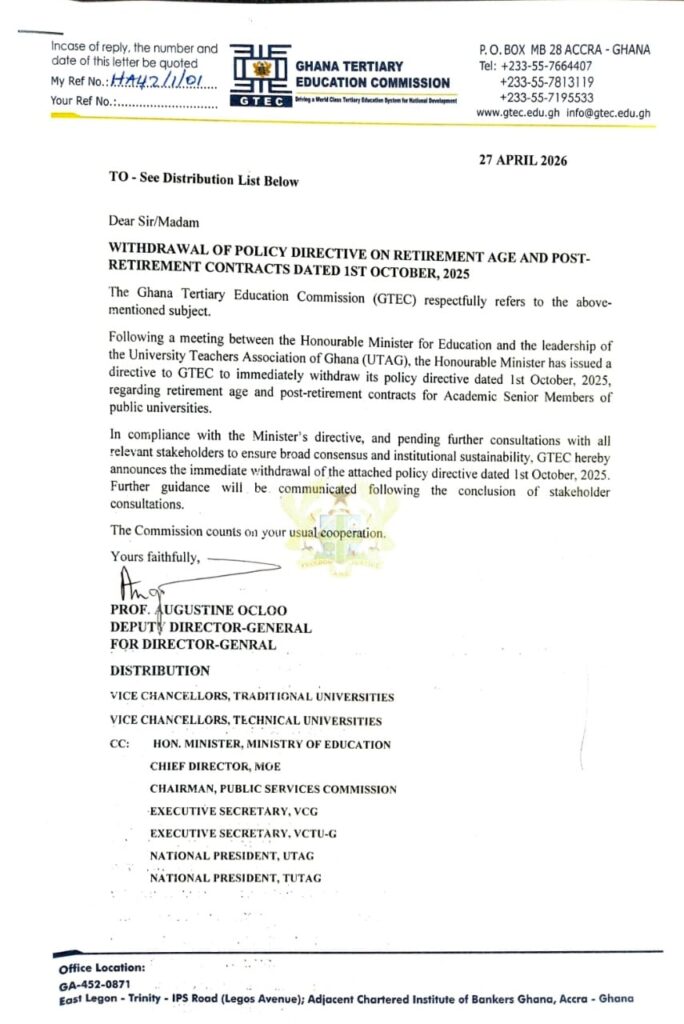
The withdrawal, announced in an official letter dated Monday, April 27, 2026, brings temporary relief to university lecturers and management who had raised concerns over the earlier guidelines.

What Was Withdrawn?
The now-withdrawn directive was issued by GTEC on October 1, 2025 (with a related letter on September 30, 2025). It sought to introduce stricter guidelines regulating:
- The mandatory retirement age for academic senior members.
- Conditions and approval processes for post-retirement contract appointments.
- Engagement of retired professors and lecturers on contract in public universities.
Many stakeholders viewed the directive as restrictive, with fears that it could disrupt academic activities, lead to loss of experienced faculty, and affect knowledge transfer, research output, and teaching quality in public universities.
Reason for the Withdrawal
The decision follows a high-level meeting between the Minister for Education, Hon. Haruna Iddrisu, and the leadership of the University Teachers Association of Ghana (UTAG).
In compliance with the Minister’s directive, GTEC announced the immediate withdrawal of the October 1, 2025 policy. The Commission stated that the move is pending further consultations with all relevant stakeholders to achieve broad consensus and ensure institutional sustainability.
The official GTEC statement noted:
“Following a meeting between the Honourable Minister for Education and the leadership of the University Teachers Association of Ghana (UTAG), the Honourable Minister has directed GTEC to immediately withdraw its policy directive dated 1st October, 2025. In compliance with the Minister’s directive, and pending further consultations with all relevant stakeholders to ensure broad consensus and institutional sustainability, GTEC hereby announces the immediate withdrawal of the policy directive.”
The letter was signed by Prof. Augustina Ocloo, Deputy Director-General of GTEC, on behalf of the Director-General. It was copied to Vice-Chancellors of traditional and technical universities, the Ministry of Education, the Public Services Commission, UTAG, and the Technical University Teachers Association of Ghana (TUTAG).
Ministry of Education’s Position
A separate press statement from the Ministry, signed by Press Secretary Hashmin Mohammed, confirmed that the withdrawal is a temporary measure aimed at fostering inclusive dialogue. The Ministry reiterated its commitment to a transparent, consultative approach in addressing matters affecting Ghana’s higher education sector.
Why This Issue Matters
Post-retirement contracts allow experienced retired academics to continue contributing through teaching, supervision of graduate students, research, and administrative roles. In many Ghanaian universities, senior lecturers and professors play critical roles in maintaining academic standards, especially in specialized fields where there is a shortage of qualified younger staff.
However, concerns have also been raised about:
- The need for proper succession planning.
- Creating opportunities for younger academics.
- Managing the wage bill and adhering to public service regulations.
The withdrawal reflects a willingness by government to listen to concerns from university teachers while balancing the long-term needs of the tertiary education system.
Reactions and Next Steps
UTAG and other academic unions are expected to welcome the decision, viewing it as a positive step toward resolving tensions. University authorities now await further guidance from GTEC after stakeholder consultations are completed.
GTEC has assured all public universities and stakeholders of its commitment to collaborative decision-making and maintaining institutional stability within the tertiary education sector. Revised guidelines are expected to be issued once broad consensus is reached.
Implications for Public Universities
- Short term: Retired academics whose contracts were affected can breathe a sigh of relief as the previous restrictions are lifted for now.
- Medium to long term: A more comprehensive and widely accepted policy on retirement and contract extensions is anticipated.
- For students and academic quality: Continuity of experienced faculty remains important for maintaining high standards in teaching and research.
This development comes at a time when Ghana’s public universities continue to face challenges including funding constraints, infrastructure deficits, and the need to improve global competitiveness.
About The Author