

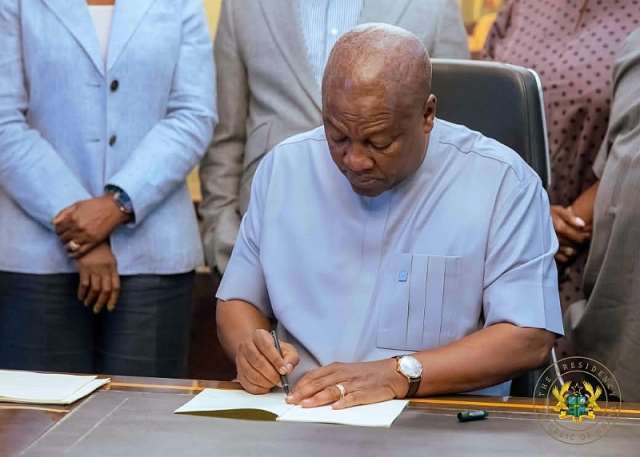
President Mahama Assents to Legal Education Reform Bill 2026: Major Overhaul for Legal Training in Ghana
In a landmark development for Ghana’s legal sector, President John Dramani Mahama has officially assented to the Legal Education Reform Bill, 2026. The signing ceremony, held today, was witnessed by key government officials including the Attorney General, Clerk of Parliament, Chief of Staff, Finance Minister, Dr. Valerie Sawyerr, and Hon. Marietta Brew.
This new law represents one of the most significant reforms in Ghana’s legal education system in decades.

Background: Longstanding Challenges in Legal Education
For many years, Ghana’s legal education system has been criticised for its restrictive nature. The Ghana School of Law held a near-monopoly on professional legal training, admitting only a limited number of students despite a growing number of LLB graduates from universities across the country.
Hundreds of qualified law graduates were often left out after failing entrance examinations or due to insufficient infrastructure and intake capacity. This situation led to public outcry, student protests, legal challenges, and widespread calls for reform to expand access while maintaining professional standards.
Key Highlights of the Legal Education Reform Act 2026
The new legislation introduces sweeping changes aimed at decentralising and democratising professional legal education:
- Ends the Monopoly of the Ghana School of Law over professional legal training.
- Empowers accredited universities (including private ones) to offer professional legal programmes.
- Establishes a new Council for Legal Education and Training to regulate standards, curriculum, and quality across institutions.
- Introduces a common bar examination to be administered for all aspiring lawyers.
- Strengthens accreditation and regulatory oversight to ensure high professional standards are maintained.
- Removes or significantly reforms the previous restrictive entrance examination system.
The reform is expected to significantly increase the number of qualified lawyers trained annually while preserving the integrity and competence required for legal practice in Ghana.
Government’s Position
Officials, including the Attorney General, have emphasised that the new law strikes a careful balance between expanded access and quality assurance. Strict accreditation requirements will be enforced to prevent any decline in standards.
Majority Leader in Parliament, Mahama Ayariga, described the bill as the fulfilment of a key campaign promise by the National Democratic Congress (NDC) to ensure equity, fairness, and broader access to legal education.
Expected Impact
- More Opportunities: Thousands of LLB graduates who were previously shut out will now have pathways to qualify as lawyers.
- Decentralisation: Legal training will no longer be centralised in Accra, potentially leading to new law schools or programmes in other regions.
- Improved Access: Especially beneficial for students from less privileged backgrounds.
- Stronger Legal Profession: A larger pool of well-trained lawyers to support justice delivery, governance, and national development.
What Happens Next?
Implementation of the new law will begin soon, with the newly established Council for Legal Education and Training expected to roll out accreditation guidelines and transition arrangements for current students and institutions.
This reform is part of broader education sector changes under the current administration aimed at modernising professional training in Ghana.
About The Author