
Volta River Authority (VRA) Salary Overview – 2026
The Volta River Authority (VRA) is a commercial State-Owned Enterprise (SOE), not a core civil or public service institution.
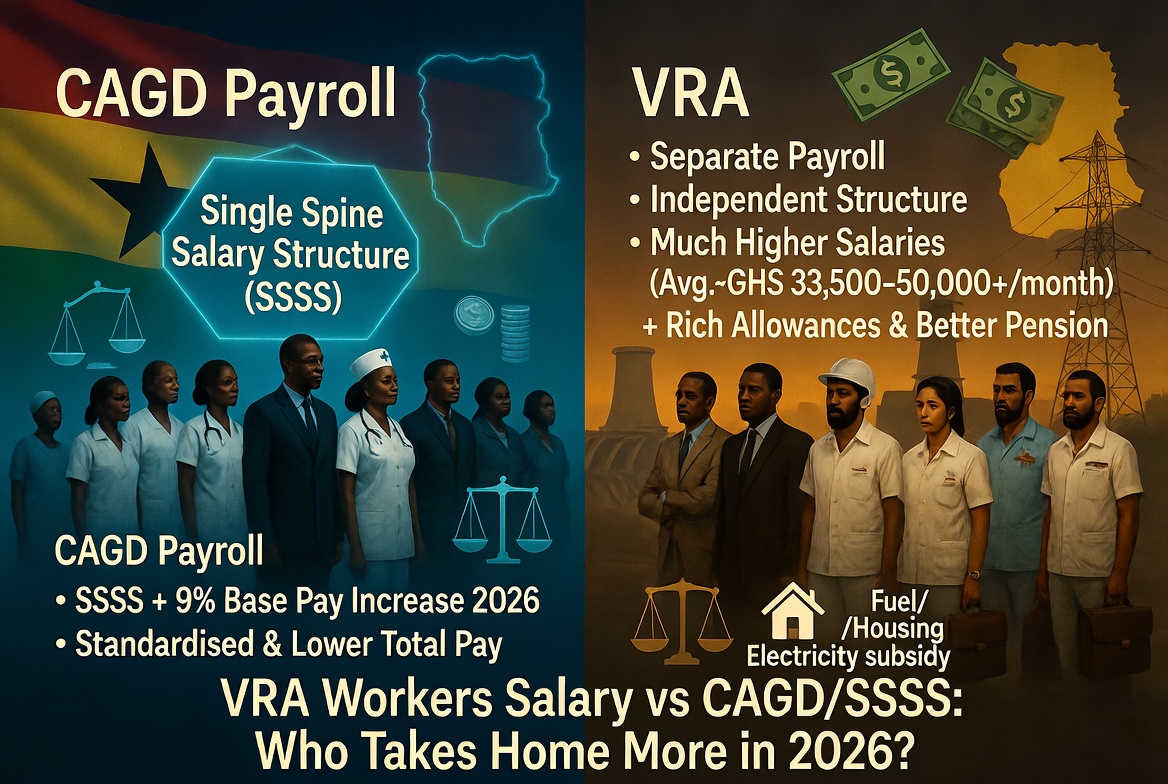
Key Point: VRA workers are NOT paid by the Controller and Accountant-General’s Department (CAGD).
They operate on a separate institutional payroll, funded mainly from VRA’s internally generated revenue (such as power sales), with some government support where necessary.
This places VRA in the same category as GRIDCo, ECG, NEDCo, COCOBOD, and other SOEs — organisations that generally offer higher total compensation than standard CAGD/SSSS workers (such as teachers, nurses, and civil servants).
1. Salary Structure at VRA
VRA operates its own independent salary structure, meaning it is not under the Single Spine Salary Structure (SSSS).
- Pay is competitive and market-oriented to attract technical talent in power generation and engineering
- Salaries are reviewed internally
- Compensation may include performance-based elements
Estimated Monthly Salaries (2026 – Approximate)
| Level / Role | Estimated Monthly Gross Salary (GHS) | Notes |
|---|---|---|
| Entry-level (fresh graduates, junior staff) | 3,000 – 4,500 | Depends on qualification |
| Mid-level (Supervisors, Technicians, Engineers) | 5,500 – 9,000+ | With experience |
| Senior Engineers / Specialists | 10,000 – 25,000+ | Technical roles |
| Average across all staff | ~33,500 (GHS 402,000 annually) | PayScale 2026 estimate |
| Overall average monthly | ~50,000+ | Varies widely by grade |
Important: These figures are significantly higher than equivalent grades on the SSSS (CAGD payroll).
Many reports suggest VRA staff may earn 5–10 times more than civil servants in similar roles — especially when allowances are included.
2. Allowances and Benefits at VRA

Because VRA operates on a separate payroll, employees enjoy more flexible and often more generous benefit packages:
- Housing / Rent Allowance
- Vehicle / Fuel Allowance
- Medical benefits (comprehensive health scheme for staff and dependents)
- Performance bonuses
- Electricity subsidy (common in power utilities)
- Training and career development support
- End-of-year bonuses tied to company performance
These additional benefits significantly increase total take-home pay compared to CAGD workers, who rely on more standardised and limited allowances.
3. Pension
VRA staff fall under the 3-Tier Pension Scheme, similar to most public sector workers.
However:
- Higher basic salaries → higher pension contributions
- Stronger Tier 1 (SSNIT) and Tier 2 (occupational pension) benefits
- Potential access to enhanced or legacy schemes in some cases
Result: VRA employees generally enjoy better retirement outcomes than SSSS workers.
4. Comparison: VRA vs CAGD / SSSS Workers (2026)
| Aspect | CAGD / SSSS Workers (e.g., GES, GHS) | VRA Workers (Separate Payroll) |
|---|---|---|
| Payroll Processor | Controller & Accountant-General (CAGD) | VRA internally |
| Salary Structure | Single Spine (25 grades) + 9% increase | Independent / company-based |
| Average Pay Level | Lower & standardised | Significantly higher (often 5x+) |
| Allowances | Harmonised, limited | More generous & flexible |
| Funding Source | Consolidated Fund (Government budget) | Mainly own revenue |
| Oversight | High (central audits, payroll control) | Internal + SIGA oversight |
| Pension Quality | Standard 3-Tier | Better (due to higher base pay) |
Why VRA Pays More
- Commercial nature → Needs highly skilled engineers and technical professionals
- Revenue-generating entity → Less dependence on government budget
- Competition with private sector → Must offer competitive pay to retain talent
- Historical autonomy → Strategic national utility with flexible compensation structure
Note on 2026 Reforms
President Mahama has declared 2026 a transition year for public sector pay reform.
The proposed National Emoluments Policy and Independent Emoluments Commission aim to reduce disparities between SSSS workers and SOEs like VRA.
However, full salary harmonisation is unlikely in the short term, meaning the pay gap between SOEs and traditional public sector workers may persist for now.
About The Author