
Understanding the Divide: Public Sector Workers Paid by CAGD vs. Those Who Aren’t – A Deeper Analysis
By Seekers Consult 247 | April 2026
In Ghana’s public sector, the question of who gets paid how much sparks endless debate — especially when salary increments, allowances, or pensions are announced.
The split between workers on the Controller and Accountant-General’s Department (CAGD) central payroll and those on separate institutional payrolls is more than just paperwork. It directly affects take-home pay, extra benefits, and retirement security.
Here’s an updated, no-nonsense breakdown with fresh 2026 insights, including who actually takes home more, why the gaps exist, and what the ongoing reforms mean for you.
1. Quick Recap: Who Is Paid by CAGD?
CAGD (Central Mechanised Payroll):
- Teachers (GES)
- Nurses/doctors (GHS)
- Civil servants in MDAs
- Local Government Service staff
- Judicial Service (non-Article 71)
- Audit Service
Salaries are drawn from the Consolidated Fund.
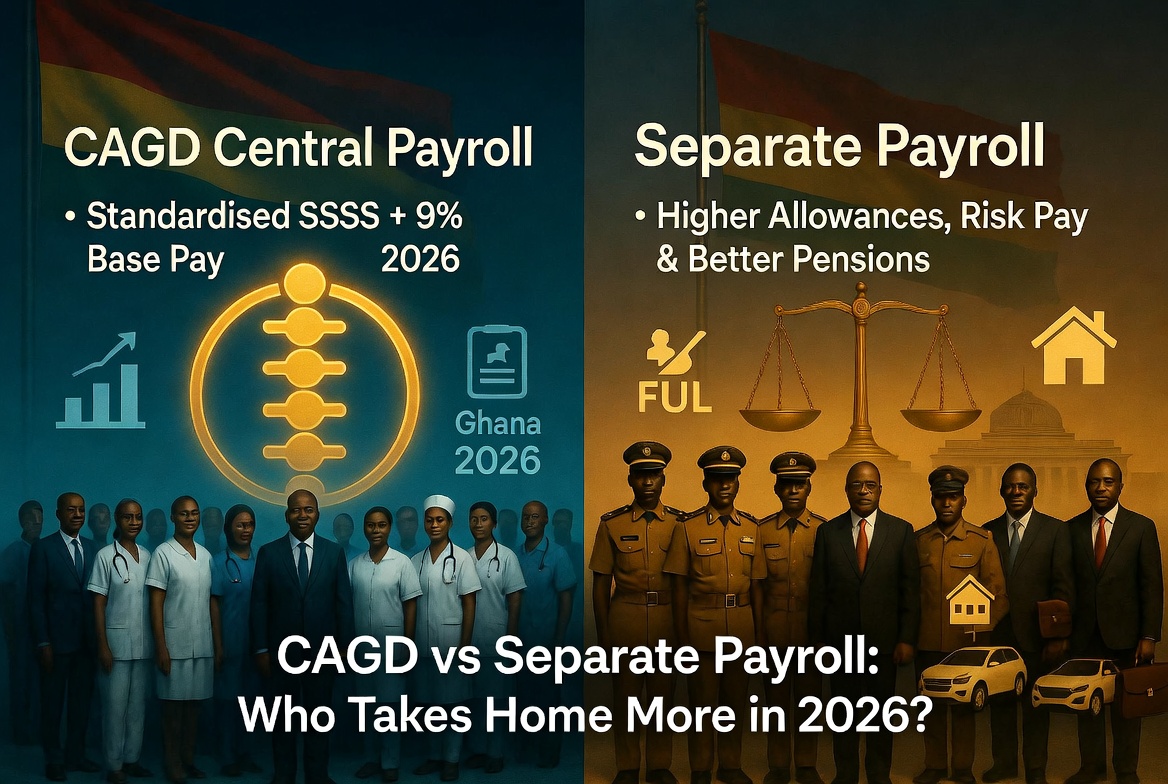
Almost all fall under the Single Spine Salary Structure (SSSS) — a 25-grade unified system with a 9% base pay increase approved for 2026.
2. Who Is NOT Paid by CAGD?
Separate Payrolls Include:
- Ghana Armed Forces (military)
- Police Service
- Ghana Revenue Authority (certain arms)
- State-Owned Enterprises (SOEs) like ECG or Ghana Water
- Article 71 office holders (President, Vice President, Ministers, MPs, Chief Justice, superior court judges, Auditor-General, etc.)
These groups process pay internally or through their institutions/ministries, even though funding often still comes from government.
3. Pay & Allowances: Who Takes More — and Why?
Short answer: Workers not on CAGD payroll (especially Article 71 holders and top security/SOE roles) generally enjoy higher total compensation — often significantly higher when allowances and perks are added.
Pay Comparison Overview (2026)
| Category | Typical Base Pay (2026) | Allowances & Perks | Total Effective Pay Advantage | Examples |
|---|---|---|---|---|
| CAGD / SSSS Workers | Standardised (Grades 1–25) + 9% increase | Harmonised premiums, inducement allowances | Lower variability; predictable but modest | Teachers, nurses, civil servants |
| Security Services | SSSS-like but separate processing | Risk, operational, overtime, housing, transport | Higher total (10–30%+ extra) | Police, Fire Service |
| Ghana Armed Forces | Separate military scale (2026 update) | Risk, peacekeeping, gratuity, housing | Higher across most ranks | Soldiers, officers |
| Article 71 Holders | Special emoluments | Fuel, housing, vehicles, ex-gratia, security | Highest (3–10x SSSS equivalents) | MPs, Ministers, Judges |
| SOE Executives | Performance-based | Bonuses, rent, vehicles | Highly variable, often top-tier | SOE CEOs |
Why Some Take Home More
- Risk and operational demands → Security and military personnel face danger, irregular hours, and deployments. Risk allowances, overtime, and peacekeeping earnings significantly boost income.
- Constitutional protection (Article 71) → Designed to ensure independence of key offices. Packages include salaries plus extensive benefits, privileges, and retirement perks.
- Flexibility for commercial roles → SOEs can offer performance-based pay to compete with the private sector.
- Historical and negotiation power → Some groups were excluded from SSSS reforms and retained stronger pay advantages.
Key Insight: Allowances alone can create huge income gaps. A Ghana Statistical Service study (2022, still relevant in 2026) showed top earners can receive disproportionately higher allowances — sometimes up to 26 times more.
4. Pensions: Why Some Get Better Packages
Most Ghanaian public workers fall under the 3-Tier Pension Scheme:
- Tier 1 → SSNIT (mandatory)
- Tier 2 → Occupational
- Tier 3 → Voluntary
Key Differences
CAGD / SSSS Workers:
- Standard 3-tier pension
- Benefits based strictly on salary history and years of service
- No special ex-gratia (except rare legacy cases)
Article 71 Holders:
- Constitution guarantees retiring benefits
- Often receive generous ex-gratia, lump sums, or enhanced pensions
Security Services & Military:
- Enhanced or separate pension arrangements
- Military personnel receive gratuity (lump sums)
- 2026 updates include cleared arrears and improved structures
Why the Pension Gap Exists
- Risk compensation (injury/death in service)
- Constitutional protections
- Historical schemes not fully harmonised
5. What This Means for You in 2026
- On CAGD payroll?
You benefit from national pay increases (like the 9% rise) and structured systems — but fewer extras and stricter rules. - On separate payroll?
You may earn more overall, especially in security or senior roles — but income may depend on institutional performance and internal policies.
Ongoing Reforms (2026 Outlook)
The government is pushing a National Emoluments Policy and proposing an Independent Emoluments Commission to:
- Reduce pay disparities
- Link salaries to productivity
- Harmonise allowances across sectors
Success will depend heavily on implementation and union negotiations.
At Seekers Consult 247, we cut through the noise so you understand exactly where you stand — whether you’re negotiating your next CBA, planning retirement, or comparing career paths.
Are you on CAGD or a separate payroll? How have allowances or pensions affected your income? Share your experience in the comments.
For the latest SSSS updates, military pay changes, and Article 71 developments, keep visiting seekersconsult247.com — your trusted source for clear, factual, and practical salary insights.
Stay informed. Stay empowered.
Seekers Consult 247 – Ghana’s trusted voice on public sector pay and pensions.
Note: Figures are approximate based on 2025–2026 announcements and public data. Actual earnings vary by rank, years of service, and location. For official guidance, consult FWSC, CAGD, or your union. Reforms are ongoing.
About The Author