
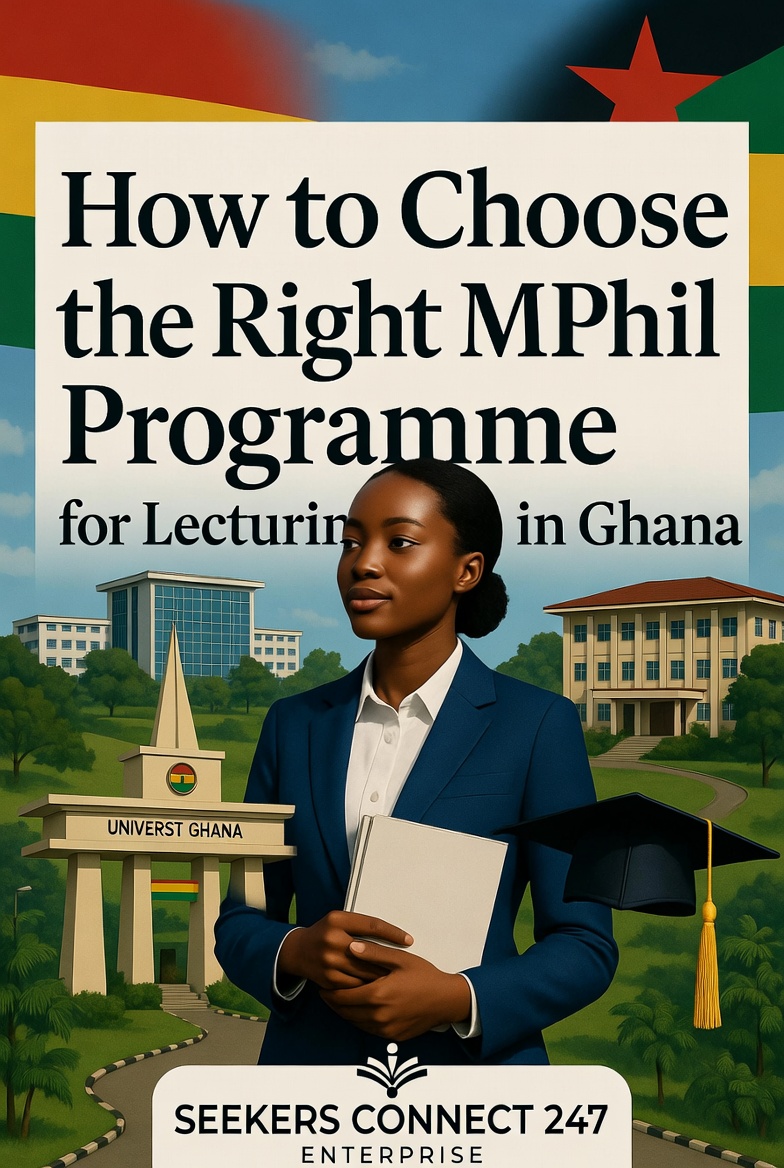
How to Choose the Right MPhil Programme for Lecturing in Ghana
Pursuing a Master of Philosophy (MPhil) is a strategic step for anyone aspiring to build a career as a lecturer or tutor in Ghana’s tertiary institutions, including universities, technical universities, and Colleges of Education. While a PhD is increasingly preferred for senior academic positions, an MPhil (a research-based master’s degree) remains a minimum qualification for entry-level lecturing roles in many institutions. It equips you with advanced subject knowledge, research skills, and teaching capabilities essential for academia.
Choosing the right MPhil programme can make or break your lecturing ambitions. A poorly aligned choice may limit your employability, while the right one positions you competitively in a growing higher education sector regulated by the Ghana Tertiary Education Commission (GTEC, formerly NCTE/NAB).
Follow us on WhatsApp for more updates: CLICK HERE
Seekers Consult
Contact Us for Your Study Abroad Journey
We search for schools and check available scholarships for you
Contact: 0550414552 / 0362297079

Loan for government workers
Transcript Application
English Proficiency
Recommendation letter
Project work/thesis for undergraduate, master’s, and PhD students.
Apply for Affidavit, Gazette instantly
Passport and Visa Applications
All other Internet Services
Step 1: Understand the Qualification Requirements for Lecturing in Ghana
Before selecting a programme, clarify what employers expect:
- For Universities and Technical Universities: The minimum requirement is typically an MPhil (or equivalent research master’s) in a relevant field. At least two of your degrees (bachelor’s and MPhil) should align in the same or closely related discipline to avoid “skirt and blouse” qualifications. MPhil holders often start as Assistant Lecturers or Lecturers, with PhD holders advancing faster to Senior Lecturer and beyond.
- For Colleges of Education: A research master’s like MPhil is now standard for tutors, especially in subject-specific areas (e.g., Mathematics Education, English Education). Professional teaching certification (e.g., PGDE or Diploma in Education) is often an advantage.
- General GTEC Guidelines: Emphasis is on research competence. Coursework-only master’s (e.g., some MA/MEd without a strong thesis component) may not suffice. A good CGPA (usually 2.5 or better, or B+ in research) and a defended thesis are crucial.
- Emerging Trends: While MPhil can get you in the door, many institutions are shifting toward requiring PhDs for full lecturer status. Plan your MPhil as a bridge to PhD.
Always verify current standards directly with target institutions or GTEC, as policies evolve.
Step 2: Align the Programme with Your Intended Lecturing Field
Your MPhil should match the subject you want to teach:
- Subject-Specific MPhil: Ideal for discipline-based lecturing. Examples:
- MPhil in English (or Teaching English as a Second Language) for language departments.
- MPhil in Mathematics Education or Basic Education for Colleges of Education.
- MPhil in Educational Administration/Leadership for management or policy roles in higher education.
- MPhil in Communication Studies, Economics, Political Science, or specialized fields like Leadership.
- Education-Focused MPhil: Programmes like MPhil in Educational Studies, Educational Leadership, or Curriculum Studies are versatile for teaching pedagogy or administration across institutions.
If your bachelor’s is in a non-education field, consider MPhil programmes that include education components or top-up options (e.g., 1-year top-up from MEd to MPhil at University of Education, Winneba).
Ensure consistency: A BA in English followed by MPhil in English strengthens your profile more than switching fields entirely.
Step 3: Evaluate Key Programme Features
Not all MPhil programmes are equal for an academic career. Prioritize these factors:
-
Research Emphasis: Look for programmes with a significant thesis component (typically the entire second year). Strong research training is non-negotiable for lecturing, as you’ll need to publish and supervise students later.
-
Accreditation and Reputation: Choose GTEC-accredited programmes from reputable public or private universities:
- University of Ghana (UG), Legon – Strong in humanities, social sciences, and sciences.
- Kwame Nkrumah University of Science and Technology (KNUST) – Excellent for STEM, engineering, and applied fields.
- University of Cape Coast (UCC) and University of Education, Winneba (UEW) – Leaders in education-related MPhils.
- Others: UPSA (Leadership), Christian Service University College, Presbyterian University, etc.
Reputable institutions enhance your CV and networking opportunities.
-
Duration and Structure: Most are 2 years (coursework + thesis). Top-up options (1 year) suit those with existing MEd/MA. Full-time vs. sandwich/part-time depends on your schedule—full-time often allows deeper research.
-
Entry Requirements: Typically, a good first degree (Second Class Lower or better, GPA ~2.0–2.5 minimum) in a related field. Some require entrance exams, interviews, or work experience (e.g., teaching background for TESL programmes). Check specific departmental requirements.
-
Faculty Expertise and Resources: Review supervisors’ profiles—experienced researchers with publications increase your chances of quality output. Consider library access, funding, and collaborations.
-
Location and Mode: Urban centres (Accra, Kumasi, Cape Coast) offer more opportunities but higher costs. Sandwich programmes suit working professionals.
-
Cost and Funding: Tuition varies; public universities are often more affordable. Explore scholarships, assistantships, or GETFund support.
Step 4: Practical Considerations and Red Flags
Follow us on WhatsApp for more updates: CLICK HERE
Seekers Consult
Contact Us for Your Study Abroad Journey
We search for schools and check available scholarships for you
Contact: 0550414552 / 0362297079
Loan for government workers
Transcript Application
English Proficiency
Recommendation letter
Project work/thesis for undergraduate, master’s, and PhD students.
Apply for Affidavit, Gazette instantly
Passport and Visa Applications
All other Internet Services
- Career Alignment: Does the programme prepare you for teaching at tertiary level? Seek those with pedagogy, academic writing, or higher education modules.
- Publication Potential: A strong thesis can lead to journal publications—key for academic progression.
- Networking: Programmes at larger universities provide better exposure to conferences and collaborations.
- Red Flags: Avoid programmes with minimal research, unaccredited status, or poor faculty-to-student ratios. Steer clear of “easy” options that don’t build rigorous skills.
Step 5: Application and Decision-Making Process
- Research multiple options via university websites (e.g., UG, KNUST, UEW admissions portals).
- Compare 3–5 programmes using a checklist: alignment, reputation, research focus, cost, duration.
- Contact departments for clarification on how their MPhil supports lecturing careers.
- Prepare strong application materials: transcripts, statement of purpose (emphasize lecturing goals), and research proposal ideas.
- Apply early—deadlines vary, often around January–March for September intake.
- Consider progression: Choose a programme that facilitates smooth PhD entry.
- Gain teaching or research experience (e.g., as a teaching assistant) alongside or before your MPhil.
- Network with current lecturers for insider advice.
- Aim for excellence: A high CGPA and quality thesis boost employability.
- Long-term view: Use your MPhil to publish, present at conferences, and build a portfolio for PhD and promotions.
Selecting the right MPhil is an investment in your future as an educator shaping Ghana’s next generation. With careful alignment to your field, institutional reputation, and research depth, you’ll be well-positioned for a fulfilling lecturing career. Start by identifying your target subject area and shortlisting accredited programmes today.
About The Author