
GTEC Mandates Certificate Verification for Ministry of Education Job Applicants
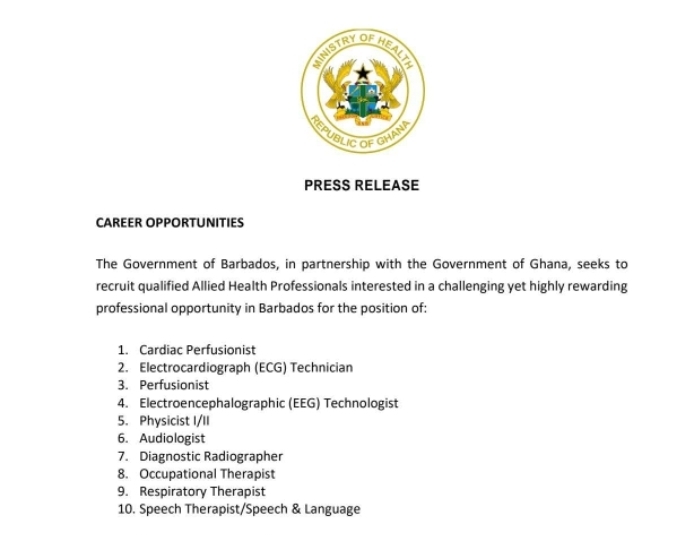
In a significant move to protect the integrity of Ghana’s education sector, the Ghana Tertiary Education Commission (GTEC) has directed all prospective applicants seeking employment in agencies under the Ministry of Education (MoE) to submit their academic credentials for verification as an integral part of the recruitment process.
The directive, issued in a statement comes shortly after clearance was granted for recruitment into various MoE agencies. It underscores the Commission’s commitment to ensuring that only individuals with authentic and accredited qualifications are hired to shape the nation’s future through education.
Contact Us for Your Study Abroad Journey
We search for schools and check available scholarships for you
Contact: 0550414552 / 0362297079

Loan for government workers
Transcript Application
English Proficiency
Recommendation letter
Project work/thesis for undergraduate, master’s, and PhD students.
Apply for Affidavit, Gazette instantly
Passport and Visa Applications
All other Internet Services
Details of the GTEC Directive
GTEC has explicitly required applicants to present their tertiary-level certificates including diplomas, bachelor’s degrees, master’s degrees, and PhDs for thorough evaluation to confirm their authenticity.
- Who is affected? All prospective applicants for positions in agencies under the Ministry of Education.
- What must be submitted? Original or clear copies of relevant academic credentials earned from both local and foreign institutions.
- Purpose: To weed out fraudulent certificates and qualifications obtained from unaccredited or unrecognised institutions.
- Urgency: The Commission has urged applicants to treat this requirement with seriousness, as verification will be a critical step before any appointment is made.
Prof. Ahmed Jinapor Abdulai, Director-General of GTEC, leads an institution mandated under the Education Regulatory Bodies Act, 2020 (Act 1023) to accredit tertiary institutions and programmes while verifying academic credentials.
This latest directive aligns with GTEC’s broader mandate to safeguard standards in tertiary education and the public sector, particularly in sensitive areas like teaching, administration, and policy roles within the education ecosystem.
Why Now? Addressing the Growing Menace of Fake Certificates
Ghana has witnessed a worrying rise in cases involving fake academic credentials, honorary titles misused as earned degrees, and qualifications from dubious or unaccredited institutions. GTEC’s action reflects ongoing national efforts to restore public confidence in the education system.
The Commission’s Credential Evaluation Department handles verification and equivalence assessments for both local and foreign certificates. Services include:
- General evaluation reports
- Credential verification and authenticity checks
- Institutional reports
- Establishment of equivalences for certificates at all levels
Fees are currently set at GH¢120 for each local certificate and GH¢307 for each foreign certificate, with processes designed to recover costs while maintaining rigour. Applicants must submit documents in person or through formal channels, and forged documents are referred to security agencies.
Recent high-profile cases including dismissals of university staff for presenting fake certificates and warnings against the misuse of honorary doctorates or unearned professorial titles have heightened scrutiny. GTEC has consistently emphasised that employers, especially in the public sector, must verify qualifications to prevent unqualified individuals from occupying critical roles.
How the Verification Process Works
How to Verify Your Certificate with GTEC (2026 Complete Guide)
If you’re in Ghana—or you hold a local or foreign qualification and need it verified for employment, further studies, or immigration—the Ghana Tertiary Education Commission (GTEC) is the official body responsible for certificate evaluation.
GTEC verifies the authenticity of your certificate, determines its equivalence to Ghanaian standards, and issues an official evaluation report.
⚠️ Important: This is not an instant online verification. It is a formal process involving document submission and fees.
GTEC does not evaluate:
- Result slips
- Attestation letters
- Uncompleted programmes
Why You Need GTEC Certificate Verification
You may need GTEC verification for several reasons:
- ✅ Required by employers (especially public sector institutions)
- ✅ Confirms foreign qualifications meet Ghanaian standards
- ✅ Helps combat fake certificates (forged documents are referred to security agencies)
Official GTEC Links
Only use verified platforms to avoid scams:
- Main Information Page: https://gtec.edu.gh/certificate-evaluation
- CEMS Portal (Start Application): https://cems.gtec.edu.gh/
- Register: https://cems.gtec.edu.gh/register
- Login: https://cems.gtec.edu.gh/login
⚠️ Avoid third-party websites claiming to offer “fast GTEC verification.”
Seekers Consult; Trusted for local and International Certificate Evaluations and Errands Services 0550414552
Step-by-Step Guide to Apply for GTEC Certificate Evaluation
1. Register on the CEMS Portal
Visit the registration page and create your account:
- Provide personal details
- Select account type
- Add address/location information
- Upload a profile picture
This is your starting point for the application.
2. Prepare Your Documents (Very Important)
Ensure you have the following:
Required Documents:
-
Signed application letter addressed to:
The Director General
Ghana Tertiary Education Commission
P.O. Box CT 3256
Cantonments, Accra(Alternatively, collect the official application form from the GTEC Secretariat.)
- Original certificate(s) + clear photocopies
- Photocopies of prior qualifications (e.g., WASSCE for degree holders)
sample letter
[Your Full Name]
[Your Address]
[City/Town]
[Phone Number]
[Email Address]
[Date]
The Director-General
Ghana Tertiary Education Commission (GTEC)
P.O. Box CT 3256
Cantonments
Accra, Ghana
Dear Sir/Madam,
APPLICATION FOR CERTIFICATE EVALUATION
I write to formally apply for the evaluation and verification of my academic certificate(s) by the Ghana Tertiary Education Commission (GTEC).
I obtained my qualification(s) from [Name of Institution], where I was awarded [Name of Certificate/Degree/Diploma] in [Year of Completion]. I respectfully request that GTEC assess and determine the equivalence of my qualification(s) to the appropriate Ghanaian standards.
This evaluation is required for [state purpose – e.g., employment, further studies, professional recognition, or immigration purposes].
I have attached the following documents in support of my application:
- Copies of my certificate(s) (with originals for verification)
- Copies of my academic transcripts (if applicable)
- Copies of prior academic qualifications
- Certified English translations (if applicable)
- Any other relevant supporting documents
I would be grateful if my application is given the necessary consideration. Please let me know if any additional information or documentation is required to facilitate the process.
Thank you for your time and assistance.
Yours faithfully,
If applicable:
- Certified English translations (if not in English) from:
- University of Ghana (Department of Modern Languages)
- Ghana Institute of Languages
- Certificates from Cuba or Russia:
- Include authentication letter from their Embassy in Ghana
- Applying on behalf of someone:
- Signed consent form from the certificate holder
⚠️ Note: All certificates must be hand-delivered. Email submissions are not accepted.
3. Pay the Required Fees
Fees are paid after document verification:
- Local certificate: GH¢120.00 per certificate
- Foreign certificate: GH¢307.00 per certificate
4. Submit Your Application
Visit the GTEC Secretariat in Cantonments, Accra with your documents:
- Originals will be examined
- Photocopies will be taken
- Staff will guide you through the remaining steps (including portal updates if needed)
5. Wait for Processing
- Processing is case-by-case
- Typically takes several weeks (longer for foreign institutions)
- GTEC verifies directly with the awarding institution
Result Delivery:
- A file copy is sent to you by post
- The original report can be sent directly to your employer or institution (on request)
6. Track Your Application
You can monitor your progress through:
- The CEMS portal (after login)
- GTEC contact line (status updates only—no report details)
- Email enquiries: evaluation@gtec.edu.gh
Important Tips & Warnings
- ⏳ No instant service – Apply well before deadlines
- 📄 Originals may be retained if fraud is suspected
- ❌ GTEC does not:
- Combine multiple certificates
- Assign job ranks
- 📝 Name change? Bring official proof (e.g., affidavit, gazette)
- 🌍 Delays may occur due to:
- Postal services
- Slow responses from foreign institutions
GTEC Contact Details
- Website: www.gtec.edu.gh
- Email: evaluation@gtec.edu.gh
- Location: Cantonments, Accra
- Onsite Appointments: 10:00 AM – 2:00 PM (schedule in advance)
Tip
Always start your application on the CEMS portal and carefully read the official guidelines before visiting the office. This helps you avoid delays and rejection.
If you follow these steps correctly, your GTEC certificate verification will be processed smoothly and officially recognized.
💬 Need help with a specific case (e.g., foreign certificates)? Drop your questions in the comments or contact GTEC directly.
Last Updated: April 2026
Source: Official GTEC Website
Broader Implications for Ghana’s Education Sector
- For Job Seekers: Genuine applicants have nothing to fear. However, those with questionable credentials risk disqualification. Early preparation and submission are advised, especially as recruitment windows open.
- For the Education System: Strengthening verification helps maintain high teaching and administrative standards, ultimately benefiting students and the quality of education delivered nationwide.
- For Public Trust: The move signals zero tolerance for fraud in a sector responsible for developing human capital. It complements other initiatives, such as audits of existing staff qualifications and crackdowns on unaccredited programmes.
Analysts view this as part of a larger push toward a more transparent and merit-based public service recruitment system. Similar calls have been made for comprehensive audits across government institutions.
Challenges and the Road Ahead
While the directive is commendable, implementation could face hurdles such as processing delays for high volumes of applications or verification of foreign credentials. GTEC has guidelines to manage these, including provisions for consent forms and potential extensions.
Longer-term, experts suggest establishing a centralised digital database of verified credentials to streamline future checks and reduce opportunities for fraud.
The Commission continues to warn institutions and individuals against unaccredited programmes and misuse of titles, reinforcing that only qualifications from recognised, accredited bodies will be accepted for employment, promotion, or further studies.
About The Author