

GES Supervisors (SISOs) Crying Out for Fair Treatment in Conditions of Service Negotiations
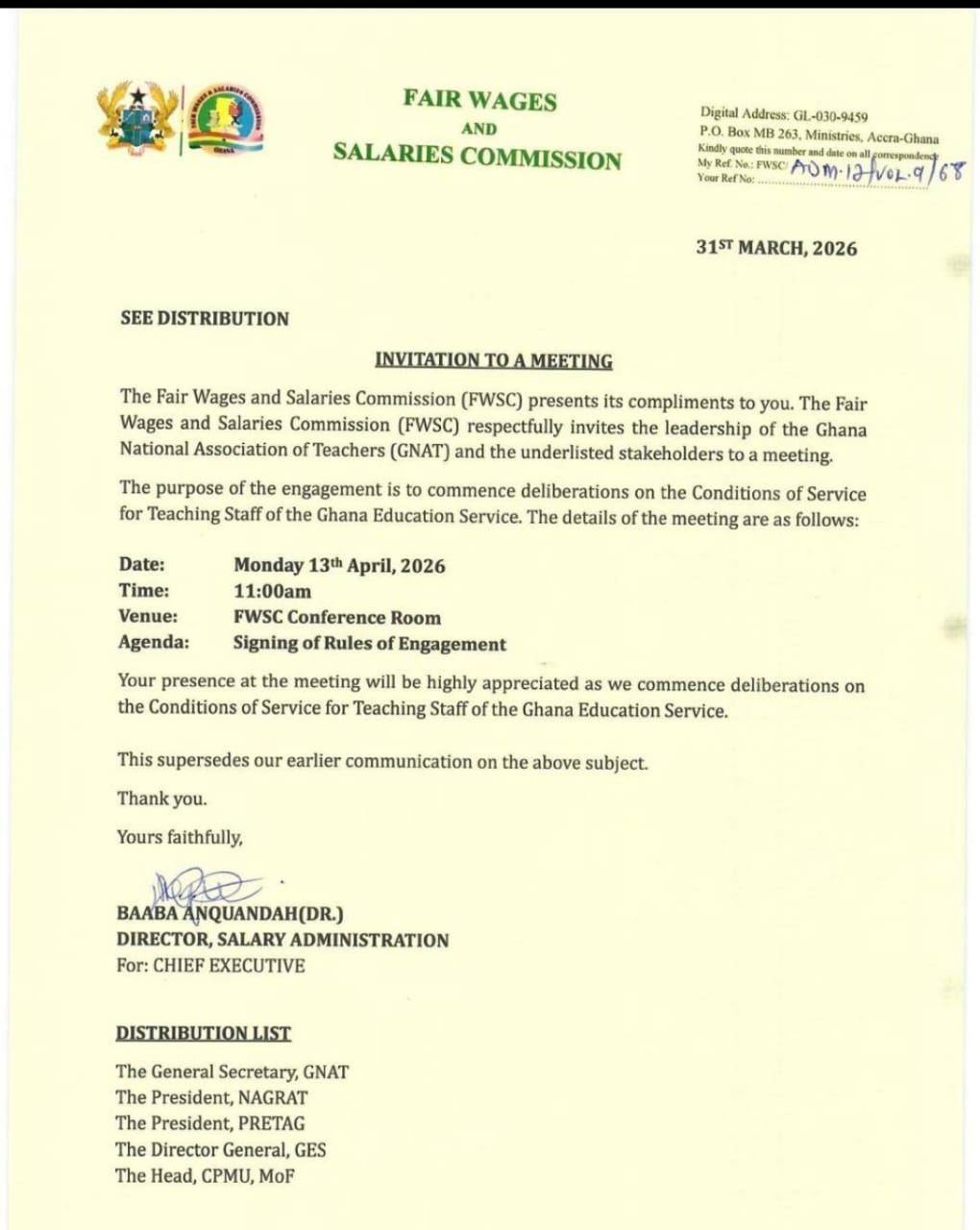
The Fair Wages and Salaries Commission (FWSC) has formally invited the leadership of the Ghana National Association of Teachers (GNAT) and other key stakeholders—including NAGRAT, PRETAG, the Director-General of the Ghana Education Service (GES), and the Head of the Central Payroll Management Unit (CPMU) at the Ministry of Finance—to a crucial meeting.
Scheduled for Monday, 13th April 2026, at 11:00 am in the FWSC Conference Room, the agenda focuses on signing the Rules of Engagement to commence deliberations on the Conditions of Service for Teaching Staff of the Ghana Education Service.
Follow us on WhatsApp for more updates: CLICK HERE
This supersedes earlier communications and comes amid ongoing calls for better welfare for educators.
In the midst of these high-level talks, a strong voice from the field is urging the teacher unions:
“Dear teacher unions, don’t forget SISOs this time in your negotiations.”
SISOs (School Improvement Support Officers), formerly known as Circuit Supervisors, are the backbone of quality assurance at the basic school level. Yet they feel chronically neglected in discussions about pay, allowances, and working conditions.
Who Are SISOs and What Do They Do?
SISOs are official GES staff posted at the circuit level. They serve as the critical link between district education offices and schools.
Core Duties:
- Supervising teaching and learning across multiple schools in their circuit.
- Mentoring teachers and headteachers.
- Monitoring school performance and implementation of national policies and curricula.
- Providing direct support to improve education quality at the grassroots.
Unlike headteachers (who supervise within one school), SISOs must travel constantly between schools—often in remote or hard-to-reach areas—making their role uniquely demanding and high-risk.
-
Follow us on WhatsApp for more updates: CLICK HERE
Seekers Consult
Contact Us for Your Study Abroad Journey
We search for schools and check available scholarships for you
Contact: 0550414552 / 0362297079

Loan for government workers
Transcript Application
English Proficiency
Recommendation letter
Project work/thesis for undergraduate, master’s, and PhD students.
Apply for Affidavit, Gazette instantly
Passport and Visa Applications
All other Internet Services
Why SISOs Are Complaining: A Cry from the Field
A SISO recently shared this open appeal (directed to teacher unions and platforms like Seekers Consult), highlighting systemic neglect:
“Before you apply for a SISO job, know that:
- There is no meaningful responsibility allowance — It is 10% of salary at Principal Superintendent (PS), Assistant Director I (ADI), and Deputy Director (DD) levels, but drops to a meagre 1.7% at Assistant Director II (ADII). If you were already on responsibility allowance before appointment, it is stripped within 3 months—or you face automatic retroactive deductions later.
- No risk allowance — Everyone commutes to work, but SISOs must constantly tour multiple schools, often on poor roads and in unsafe conditions. Accidents in the line of duty are common; many have died. The latest was Anthony Gligbe in North Tongu (November 2025) while returning from work. If you suffer an accident, you are on your own.
- No fuel allowance (or it is negligible/non-existent for SISOs). Fuel costs come out of your own pocket.
- No motor maintenance allowance — You maintain your own motorcycle or vehicle at personal expense.
- Personal time is an illusion — Even if you spend 2–3 days moving between schools, the rest of the week is consumed by meetings, workshops, and other official engagements.
- Any agreed benefits for SISOs must go through CAGD/payslip, not through the directorate or “over the table.” Anything else risks immediate problems with payroll.
SISOs feel that while unions fight for teachers, the unique mobility, supervisory risks, and logistical burdens of their role are repeatedly overlooked. Their work directly supports classroom teachers, yet they lack the tools and protections needed to do it effectively.
How to Become a SISO
Becoming a SISO is a promotional opportunity open to experienced serving GES personnel. Recent vacancy announcements (e.g., in Wa Municipality, February 2026) outline these key requirements:
Requirements:
- You must be a graduate professional teacher with not less than 10 years of working experience.
- You must hold the rank of Assistant Director I (or Assistant Director II or above) and have served on that rank for a minimum period (typically 2 years in some calls).
- Additional advantages include a Second Degree (Master’s) in Education or a related field, strong supervisory knowledge, computer literacy, and proven discipline/results-oriented attitude.
- You must be energetic, committed, and willing to work anywhere in the municipality/district.
Application Process:
- Type-written application letters.
- First appointment letter.
- Last promotion letter.
- Personal record form.
- Certificates.
- Current payslip.
- Confidential report.
- Recent workshop certificates.
SISOs are drawn from the senior ranks of classroom teachers and headteachers who have demonstrated excellence and leadership.
Allowances SISOs Are Supposed to Enjoy (But Often Don’t Fully Receive)
Under GES collective agreements and public service rules, field-based supervisory officers like SISOs should benefit from allowances that recognise their mobility and responsibilities.
Expected Allowances:
- Responsibility Allowance — A step increment on the Single Spine Salary Scale (not a flat 10% cash payment). It should reflect added supervisory duties.
- Risk Allowance — Designed for roles involving travel and potential hazards (historically up to 30% of basic salary for designated staff).
- Fuel Allowance / Travelling Allowance — To cover official movement between schools.
- Motor Maintenance / Vehicle Maintenance Allowance — For upkeep of motorcycles or vehicles used in duty (standard rates exist for official transport use, e.g., mileage/kilometric allowances).
- Other transport-related benefits (e.g., night subsistence, removal/transfer grants) when applicable.
In practice, SISOs report that these are either absent, negligible, or clawed back, forcing them to subsidise their work with personal funds. This undermines their ability to perform routine school visits and support teaching quality.
As the April 2026 FWSC meeting approaches, SISOs are asking unions not to leave them behind again. Their role is indispensable to improving learning outcomes in basic schools, yet they operate under conditions that discourage dedication and expose them to unnecessary hardship.
Teacher unions have the platform—may the unique needs of SISOs not escape the negotiations.
Fair wages and salaries must reflect the real risks and sacrifices of every cadre supporting Ghana’s education system.
SISOs continue to serve with commitment. The least they deserve is recognition and proper conditions of service that match the demands of their job.
The ball is now in the court of the unions and FWSC.
HOME
-
Follow us on WhatsApp for more updates: CLICK HERE
Seekers Consult
Contact Us for Your Study Abroad Journey
We search for schools and check available scholarships for you
Contact: 0550414552 / 0362297079
Loan for government workers
Transcript Application
English Proficiency
Recommendation letter
Project work/thesis for undergraduate, master’s, and PhD students.
Apply for Affidavit, Gazette instantly
Passport and Visa Applications
All other Internet Services
About The Author