
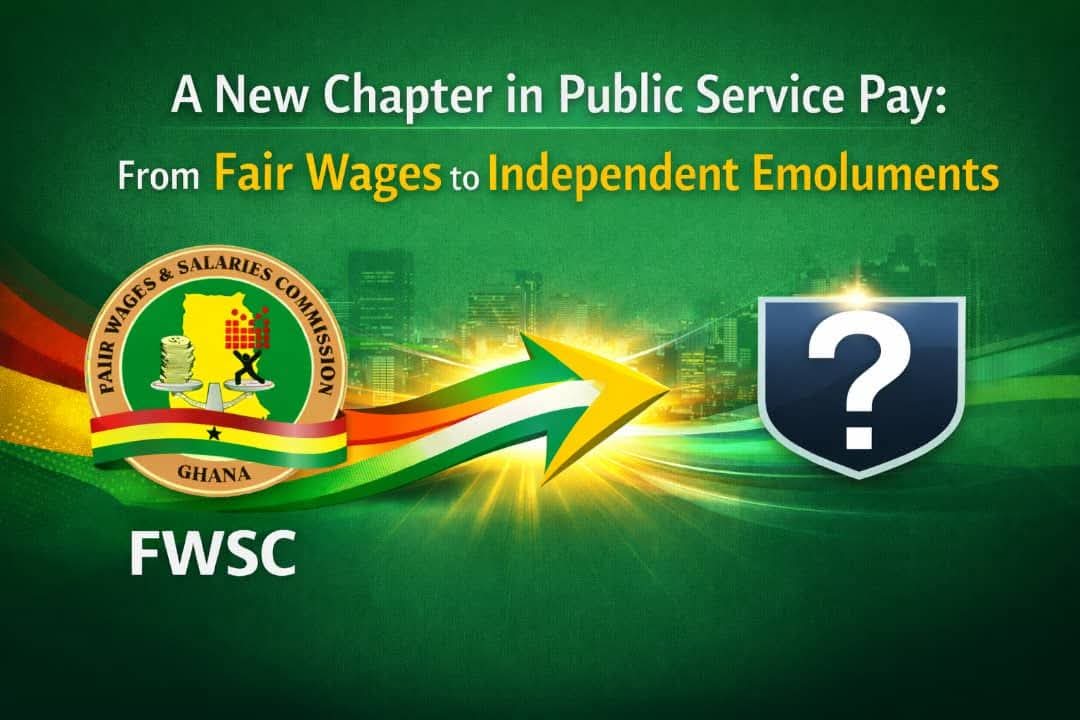
The ongoing transition from the Fair Wages and Salaries Commission (FWSC) to the Independent Emoluments Commission, and what this means for public sector workers.
A New Chapter in Public Sector Compensation: 2026 Salary Updates and Reforms
Public sector workers in Ghana entered 2026 with a mix of modest salary adjustments and ambitious institutional reforms aimed at creating a more transparent and sustainable pay system. The Fair Wages and Salaries Commission (FWSC) recently shared an update signaling major changes:
“A new chapter is unfolding in public service compensation. The transition from the Fair Wages and Salaries Commission to the Independent Emoluments Commission is underway — carefully, deliberately, and with purpose. We are building a stronger, more transparent, and future-ready system for public service pay. Stay with us. The journey has begun.”
the beginning of a structural overhaul of how public sector emoluments are managed.
1. The 2026 Base Pay Increase: 9% Across the Board
In November 2025, the Government of Ghana (represented by the FWSC and Ministry of Finance) and Organised Labour signed an agreement on base pay for the 2026 fiscal year. The key outcome is a 9% increase in the base pay on the Single Spine Salary Structure (SSSS), effective from January 1, 2026, to December 31, 2026.
- Who is covered? All public sector workers on the SSSS, including those in education, health, civil service, security services, and other government institutions.
- National Daily Minimum Wage: A corresponding 9% increase was approved, raising it from GH₵19.97 to GH₵21.77 per day for the same period.
- Context of the negotiation: This follows a 10% increase in the previous year. Labour unions had pushed for higher adjustments amid economic pressures, but the final agreement reflects efforts to balance worker demands with fiscal sustainability.
The SSSS remains the cornerstone of public service pay in Ghana. Introduced to promote “equal pay for work of equal value,” it uses a unified grading system based on job evaluation. Salaries consist of a base pay (adjusted annually) plus allowances and market premiums for critical skills. The 9% uplift applies uniformly across grades and steps on the structure.
Note for workers: Your March or April 2026 payslip should reflect the new rates (depending on payroll processing cycles). Specific grade-by-grade breakdowns are typically published by the FWSC or individual institutions like the Ghana Education Service. Check your institution’s HR or the official FWSC website for detailed pay scales.
2. No Full Renegotiation of Conditions of Service in 2026
President John Dramani Mahama explicitly stated during engagements with Organised Labour that 2026 will not be a year for full renegotiation of conditions of service in the public sector. The focus instead is on the institutional transition. This means existing allowances, market premiums, and other negotiated benefits largely remain in place while the new framework is developed.
However, unions have been assured that pending issues and specific conditions of service will continue to be addressed through normal channels.
Follow us on WhatsApp for more updates: CLICK HERE
Seekers Consult
Contact Us for Your Study Abroad Journey
We search for schools and check available scholarships for you
Contact: 0550414552 / 0362297079

Loan for government workers
Transcript Application
English Proficiency
Recommendation letter
Project work/thesis for undergraduate, master’s, and PhD students.
Apply for Affidavit, Gazette instantly
Passport and Visa Applications
All other Internet Services
3. The Big Reform: Transition to the Independent Emoluments Commission
The most significant development is the government’s declaration of 2026 as the transition year from the Fair Wages and Salaries Commission to a new Independent Emoluments Commission (IEC).
- Announcement: President Mahama made this declaration in mid-March 2026 during a dialogue with organised labour.
- Purpose: To create a stronger, more transparent, rule-based, and evidence-driven system for managing public service pay, reducing fragmentation and improving credibility.
- Role of FWSC: The existing Fair Wages and Salaries Commission will not be dismantled. Instead, it will be reinforced and repositioned — with enhanced financial and human resources — to serve as the technical backbone of the new Independent Emoluments Commission.
This reform builds on long-standing discussions (including earlier recommendations from the FWSC itself) about the need for an independent body to handle emoluments for public officials, reduce inequities, link pay more closely to performance where possible, and ensure fiscal sustainability.
The President emphasized that the transition is deliberate and careful, aiming for professionalism and independence in salary administration.
Follow us on WhatsApp for more updates: CLICK HERE
Seekers Consult
Contact Us for Your Study Abroad Journey
We search for schools and check available scholarships for you
Contact: 0550414552 / 0362297079
Loan for government workers
Transcript Application
English Proficiency
Recommendation letter
Project work/thesis for undergraduate, master’s, and PhD students.
Apply for Affidavit, Gazette instantly
Passport and Visa Applications
All other Internet Services
Background: The Single Spine Salary Structure (SSSS)
For context, the SSSS was introduced under the Single Spine Pay Policy to address historical distortions and inequalities in public sector pay. Managed by the FWSC (established by Act 737, 2007), it involves:
- Job evaluation and grading.
- Determination of base pay and pay-point relativities.
- Negotiation of allowances.
- Efforts to attract and retain critical skills.
Challenges over the years have included a rising wage bill, demands for job grade reviews (as jobs have evolved since the last major evaluation around 2008), and calls for better linkage between pay and productivity.
What This Means for Public Sector Workers
Positive aspects:
- Momentum toward a more independent and transparent pay system that could reduce ad-hoc decisions and inequities.
- Continued focus on implementing pending conditions of service.
About The Author