
Guide to Birth Certificates in Ghana: Why You Need One, Who Requires It, and How to Get Yours
Your child’s first official identity – and the key that unlocks almost every other document in life
In Ghana, a birth certificate isn’t just a piece of paper. It’s the foundational proof of your existence – recording your name, date and place of birth, and your parents’ details. Issued by the Births and Deaths Registry (BDR) under the Ministry of Local Government, Decentralisation and Rural Development, it serves as the gateway to citizenship rights, education, jobs, travel, and more.
Whether you’re a new parent rushing to register your newborn or an adult still chasing that elusive document for your Ghana Card or passport, this guide covers everything you need to know.
Follow us on WhatsApp for more updates: CLICK HERE
Seekers Consult
Contact Us for Your Study Abroad Journey
We search for schools and check available scholarships for you
Contact: 0550414552 / 0362297079

Loan for government workers
Transcript Application
English Proficiency
Recommendation letter
Project work/thesis for undergraduate, master’s, and PhD students.
Apply for Affidavit, Gazette instantly
Passport and Visa Applications
All other Internet Services
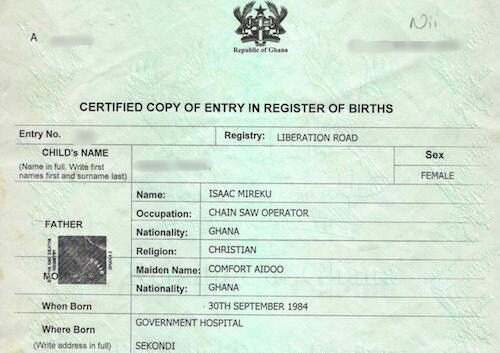
What Exactly Is a Birth Certificate? A birth certificate (or more formally, a Certified Copy of Entry in the Register of Births) is an official government document that legally records a child’s birth. In Ghana:
- It is issued free of charge for infants registered within the first 12 months of birth.
- For children over 1 year (late registration), small administrative fees and penalties apply.
- Adults over 60 may need a High Court declaration instead.
The document proves your age, parentage, and Ghanaian citizenship critical in a country where birth registration rates hover around 60%. Without it, life gets complicated fast.
Why Birth Certificates Matter
According to Ghana’s Registration of Births and Deaths Act (updated 2020), every child has a right to be registered. The birth certificate isn’t optional; it’s your child’s ticket to:
- Legal identity
- Access to social services
- Protection under the UN Convention on the Rights of the Child (which Ghana ratified)
Missing it can block school admission, delay passports, and even complicate inheritance claims. Recent laws now make it mandatory for basic school and pre-school enrolment – schools must report unregistered children to the BDR.
When Do You Actually Need a Birth Certificate?
Here are the most common situations where a birth certificate becomes non-negotiable:
- School Enrolment – From kindergarten to university, it proves age and eligibility. Basic schools now require it by law.
- National ID (Ghana Card) – The National Identification Authority (NIA) lists it as a primary document for registration.
- Passport Application – Ghana Immigration Service and Passport Offices demand it as proof of citizenship and identity.
- Driver’s Licence – DVLA requires it alongside other IDs.
- Voter Registration & Electoral Commission services
- Employment & Job Applications – Many employers (especially public sector and formal jobs) ask for it.
- Bank Accounts, Insurance & SSNIT Contributions – Financial institutions need it to verify identity and age.
- Marriage, Inheritance & Legal Proceedings – Courts and registries often request it.
- International Travel & Visas – Especially for children or first-time passport applicants.
- Higher Education & Scholarships – Universities and scholarship bodies use it for age verification.
In short: If it involves official Ghanaian identity, a birth certificate is usually the starting point.
Which Institutions Specifically Ask for It?
Here’s a handy list of major institutions that routinely demand an original or certified birth certificate:
- Births and Deaths Registry (BDR) – Obviously!
- National Identification Authority (NIA) – For Ghana Card issuance.
- Ghana Passport Office / Ghana Immigration Service – Mandatory for new or replacement passports.
- Driver and Vehicle Licensing Authority (DVLA) – For learner’s or full driver’s licence.
- Electoral Commission – Voter ID processes.
- Ministry of Education & Schools – Enrolment at all levels.
- Banks & Financial Institutions – Account opening, loans, insurance.
- Social Security and National Insurance Trust (SSNIT) – Pension and contribution registration.
- Hospitals & NHIS – For accurate medical records and health insurance.
- Employers & Public Service Commission – Recruitment and verification.
- Courts & Registrar General’s Department – Legal name changes, adoptions, inheritance.
How to Get a Birth Certificate in Ghana
1. Infant Registration (0–12 months) – Free & Fast
- Go to the nearest BDR office in the district where the birth occurred.
- Bring: Maternal Health Record Book (weighing card) + parents’ IDs.
- Provide full bio-data (child’s name, parents’ details, occupation, religion, nationality).
- Certificate issued instantly or within 1 day.
2. Late Registration (1 year and above)
- Same office, but you’ll fill a late registration form.
- Fees: Small penalties apply
- Processing: Up to 2 weeks or more.
- For adults over 60: Court declaration required.
3. Certified True Copy (if you already registered but lost the original)
- Apply at any BDR office with proof of identity.
Follow us on WhatsApp for more updates: CLICK HERE
Seekers Consult
Contact Us for Your Study Abroad Journey
We search for schools and check available scholarships for you
Contact: 0550414552 / 0362297079
Loan for government workers
Transcript Application
English Proficiency
Recommendation letter
Project work/thesis for undergraduate, master’s, and PhD students.
Apply for Affidavit, Gazette instantly
Passport and Visa Applications
All other Internet Services
About The Author