
Fair wages and salary Commission update to teacher unions
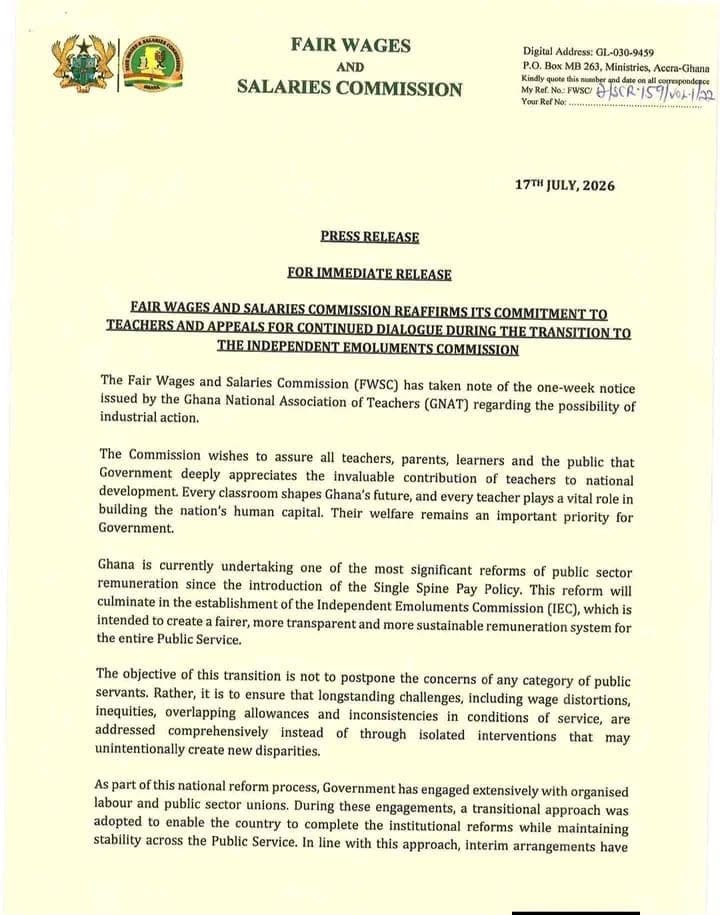
Table of Contents
ToggleFAIR WAGES AND SALARIES COMMISSION REAFFIRMS ITS COMMITMENT TO TEACHERS AND APPEALS FOR CONTINUED DIALOGUE DURING THE TRANSITION TO THE INDEPENDENT EMOLUMENTS COMMISSION
The Fair Wages and Salaries Commission (FWSC) has taken note of the one-week notice issued by the Ghana National Association of Teachers (GNAT) regarding the possibility of industrial action.
The Commission wishes to assure all teachers, parents, learners and the public that Government deeply appreciates the invaluable contribution of teachers to national development. Every classroom shapes Ghana’s future, and every teacher plays a vital role in building the nation’s human capital. Their welfare remains an important priority for Government.

Ghana is currently undertaking one of the most significant reforms of public sector remuneration since the introduction of the Single Spine Pay Policy. This reform will culminate in the establishment of the Independent Emoluments Commission (IEC), which is intended to create a fairer, more transparent and more sustainable remuneration system for the entire Public Service.
What the FWSC Statement Means for Ghanaian Teachers
The FWSC statement is important because it comes amid growing discussions over teachers’ conditions of service, remuneration, allowances and the future structure of public-sector pay.
GNAT had issued a one-week notice concerning possible industrial action, prompting the FWSC to appeal for continued engagement rather than immediate industrial action.
The Commission acknowledged the concerns of teachers while arguing that Ghana is currently undergoing a major transformation of its public-sector compensation system.
According to the FWSC, the reform is intended to address structural problems rather than resolve individual salary or allowance concerns in isolation.
Why Teachers’ Conditions of Service Are at the Centre of the Discussion
Teachers constitute one of Ghana’s largest groups of public-sector workers, and their remuneration has frequently been a subject of negotiations between government and organised labour.
Earlier in 2026, GNAT called for a review of the Single Spine Pay Policy, arguing that existing salary arrangements were not adequately reflecting teachers’ training, workload and contribution to national development.
The concerns extend beyond basic salaries.
Teachers and their unions have raised issues involving:
- Allowances and incentives
- Conditions of service
- Working conditions
- Compensation for teachers in deprived and rural areas
- Career progression
- Professional welfare
- Equity within the public-sector salary structure
These concerns form part of the broader debate about whether Ghana’s current compensation arrangements adequately reward public servants for the responsibilities they undertake.
What Is the Single Spine Pay Policy?
The Single Spine Pay Policy (SSPP) was introduced as Ghana’s major public-sector remuneration framework to help create a more orderly and equitable salary structure.
The policy was intended to establish a common framework for determining public-sector salaries based on job evaluation and grading.
However, the FWSC has acknowledged that the existing system has not fully achieved all of its intended objectives.
In a separate statement in 2026, FWSC Chief Executive Dr George Smith-Graham said the current system had experienced challenges involving pay disparities and other structural problems. The Commission has consequently been working towards a new compensation architecture.
The reform is therefore being presented not simply as another salary adjustment but as a fundamental review of how public-sector compensation is determined.
The Proposed Independent Emoluments Commission
One of the most important elements of the reform is the proposed Independent Emoluments Commission.
The FWSC says the new institution is intended to provide a more transparent, equitable and sustainable approach to public-sector remuneration.
There is an important distinction in the terminology being used in recent public discussions.
The uploaded July 17 press release refers to an Independent Emoluments Commission (IEC), while later official FWSC communications refer to an Independent Public Emoluments Commission (IPEC) in connection with the broader reform agenda.
In July 2026, the government also accepted the Constitutional Review Committee’s recommendation for an Independent Public Emoluments Commission to determine the salaries and benefits of Article 71 office holders. The proposed commission would cover positions including the President, Members of Parliament, the Judiciary and heads of certain constitutional bodies.
This illustrates that Ghana’s compensation reforms have both a public-service pay dimension and a broader constitutional dimension concerning Article 71 emoluments.
Why Is Ghana Reforming Public-Sector Pay?
According to the FWSC, the existing system has experienced several problems over time.
These include:
1. Wage distortions
Workers in different positions may sometimes receive compensation that does not adequately correspond to differences in responsibility, qualifications, skills or working conditions.
2. Inequities
Differences in compensation can emerge between groups of workers performing comparable responsibilities.
3. Overlapping allowances
Various allowances have developed across different sectors, sometimes producing inconsistencies in the overall compensation structure.
4. Inconsistencies in conditions of service
Different public-sector institutions and occupational groups can have varying conditions of service, creating challenges in maintaining a coherent national compensation system.
The FWSC argues that these problems require a comprehensive approach rather than isolated salary interventions.
FWSC Says Reform Is Not Intended to Delay Teachers’ Concerns
A major point in the July 17 statement is the Commission’s assurance that the transition should not be interpreted as an attempt to ignore or indefinitely postpone teachers’ concerns.
The FWSC said the purpose of the transition is to address longstanding remuneration challenges comprehensively.
The Commission also acknowledged that teachers have legitimate concerns, including issues related to incentives for workers serving in rural and deprived communities.
However, it noted that some of these concerns affect other categories of public servants as well and therefore need to be considered within the wider compensation framework.
This is one reason the Commission is advocating a broader reform instead of negotiating each issue separately.
Government’s Transitional Approach
The FWSC explained that government had engaged extensively with organised labour and public-sector unions during the reform process.
A transitional approach was adopted to allow institutional reforms to proceed while maintaining stability within the Public Service.
According to the Commission, interim arrangements had been concluded across almost the entire public sector, after which a comprehensive review of remuneration and conditions of service would take place under the new framework.
The idea is to prevent sudden changes from creating additional disparities while the new compensation system is being developed.
Teachers’ Possible Industrial Action
The FWSC’s statement followed a one-week notice from GNAT regarding possible industrial action.
The Commission appealed to GNAT to suspend any planned industrial action and continue negotiations with government.
The appeal was publicly reported on July 18, 2026, with the FWSC stressing the importance of dialogue in resolving concerns relating to teachers’ conditions of service.
Industrial action by teachers can have significant consequences because of the number of schools and learners affected.
A prolonged disruption could affect:
- Classroom instruction
- Internal school activities
- Assessment schedules
- Academic calendars
- Examination preparation
- Parents and guardians
- The broader education system
Consequently, both teacher unions and government have strong incentives to find negotiated solutions.
Why the Government Wants Dialogue
The FWSC’s appeal for dialogue reflects the government’s desire to prevent labour disputes from escalating while the compensation reforms are being implemented.
The Commission has argued that the new remuneration architecture should help address some of the structural issues that contribute to recurring disputes.
In July 2026, the FWSC said it expected the proposed new system to contribute to a significant reduction in public-sector strike actions once the Independent Emoluments Commission becomes fully operational. The Commission’s Chief Executive projected a reduction of 90% or more in public-sector strikes under the new framework.
Whether that target can ultimately be achieved will depend on how effectively the new system is designed and implemented.
The Role of Job Evaluation
Another major component of the reform is job evaluation.
Job evaluation involves assessing jobs according to factors such as:
- Skills required
- Responsibilities
- Complexity
- Accountability
- Working conditions
The aim is to determine the relative value of different jobs and establish compensation structures that are more consistent and defensible.
In June 2026, FWSC trained HR professionals from public universities in job evaluation techniques as part of the transition towards the new compensation framework. The Commission said job evaluation would be an important component of the wider review of Ghana’s public-sector compensation system.
What This Could Mean for Teachers
If properly implemented, the proposed reforms could have significant implications for teachers.
A more comprehensive compensation system could potentially provide:
Greater transparency:
Teachers and other public servants could have a clearer understanding of how their remuneration is determined.
Improved equity:
Jobs with comparable responsibilities and requirements could be evaluated more consistently.
Better recognition of difficult working conditions:
Factors such as location, responsibility and working environment could receive greater consideration.
Reduced salary distortions:
The new system could address inconsistencies that have developed over time.
More sustainable negotiations:
Rather than repeatedly addressing individual allowances, a comprehensive framework could provide a more predictable basis for remuneration discussions.
However, these benefits will depend heavily on the details of the eventual legislation, implementation arrangements and continued engagement with organised labour.
Organised Labour Wants to Be Part of the Process
The government’s reform process has attracted participation from organised labour.
In August 2026, the FWSC held a two-day stakeholder engagement with organised labour on the proposed replacement of the existing framework with the Independent Public Emoluments Commission.
More than 50 labour groups participated, including the Trades Union Congress (TUC), Ghana Federation of Labour (GFL), CLOGSAG, UTAG and the Ghana Registered Nurses and Midwives Association (GRNMA).
Organised Labour pledged to participate in the establishment of the new commission but also called for labour to remain involved throughout the process.
This is significant because the success of a national compensation framework will depend partly on whether workers and their representatives consider the system legitimate and fair.